|
|
|||||||||||
|
Tools
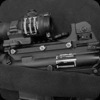
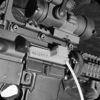
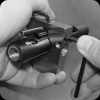
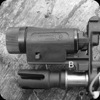
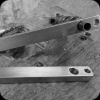
ILM - (Ideal Light Mount, Patent Pending)("B" in the image). I feel that far and away the best place for a light on one of these is between the bore and the front sight. Fortunately, on the AR there is plenty of room between the two. Why is it better? Well, two things you need to make a shot using a rifle-mounted light are to have the bore clear of, say, a barricade, and to be looking through the sights. If you are doing this and the light is mounted between the two, there can be no problem. With an under-mounted light, you might be using the sights and have the bore clear of the barricade, but now, to get the light clear, you need to come up from cover another three-plus inches. Plus, until you do, if your light is on you may backlight the barricade and lose your night vision temporarily. The same goes for a light that is mounted on the left or right-- it makes side barricade shooting harder. You either step out from behind cover further or flash the back of the barricade. Also, having it further forward than most mounts is a big advantage in terms of casting a shadow. I've seen plenty of lighting setups where the barrel and flash suppressor are blocking maybe 1/3 of the light being put out. If it's mounted on the right, for example, you'll have a big dark zone on the left, and worse, that dark zone bounces around as you move-- just what you don't need if you're out there lighting things up and looking for movement. Another advantage to the top and forward position is that your light does not light you up as much. Mounted rear and right side again as an example, the front 1/3 of your rifle's right side is painted by your own light, making you very high profile, even to someone behind you on the right.This position also makes the light a lot more knock-proof. It's not adding to the height or width of the rifle, and it's in a "protected zone"; much less likely to take a beating, or catch and slow you down, going through a door or going prone in a hurry. The ILM is best suited for one of the smaller lights. I find the SureFire X200 or the Streamlight TLR1 can do most or all of what the bigger lights can do, with the big advantage of being low-weight and low bulk. My personal light philosophy at this time is to have two of these mounted on a rifle, one with a tape switch and one without. This way-- since things can go wrong with the best of lights-- you are sure to have light when you need it, without a big weight and bulk penalty. The ILM as shown is one of several patent-pending versions. This one requires a slight mod to the front sight base and is available at $145 which includes return shipping of your top end or front sight base. Other versions that attach to the barrel are developed and soon to be available. Watch for the ILM-JT, which mounts the excellent Streamlight TLR2 upside-down so that the laser is just skimming the top of the barrel, about 5/8" from the center of the bore. This eliminates the point of aim / point of impact concerns with most laser mounting options, which put the laser up to 3" from the bore, and often to one side. This setup is nearly impossible to use well: if the laser is 3" from the bore at 1:30, and is zeroed at 10 yards, at 30 yards the point of impact will be 6" off high and right, not to mention that everything from contact to 10 yards will be off low and left by up to 3". With the ILM-JT zeroed at 15 yards, from contact distance to 15 yards thePOI will be no more than 5/8" low. Out to 30 yards it will be no more than 5/8" high. Even at 60 yards, probably further than the laser would be used, the POI would be less than 1 1/4" high. Where the top of the ILM-JT brackets the front sight base, it is drilled for tritium, so attaching the tritium-equipped ILM-JT gives instant night sights without resorting to a tritium-equipped front sight post, which are so wide as to inhibit precision shooting at distance and are much more difficult to adjust for elevation than a standard front sight post. Since shooting with night sights is not going to be a long range affair, the inserts are postioned just a little lower than the tip of the front sight, so that close-up shots are to the point of aim. The inserts are recessed forward so they are for "your eyes only". They are not visible from the sides; someone would have to be literally looking over your shoulder to see them. Two pins protrude from the rear of the ILM-JT at the top, to locate it properly to the front sight base. See picture #63 in the Photo Gallery.
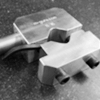
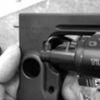
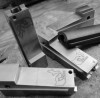
• MOACKS bare, $130 Also available, Starrett automatic center punch. This is the tool I use for counter-staking the carrier key screw when I am using the MOACKS (although the Pocket MOACKS does include a counter-staking feature). After staking the carrier key screws in using the MOACKS, this tool makes it easy to countersatke the screw heads at 4:00 and 10:00, displacing some screw head metal outward. This way if the screw ever did try to turn despite the MOACKS staking job (never heard of it happening), the outwardly-displaced screw metal would stop on the inwardly-displaced metal from the MOACKS staking of the carrier key. The tool is easy to use since no hammer is necessary; put it where you want it, push on it, and it "cocks" itself and then delivers a strike to the punch via an internal mechanism. A quality product from a good old American name in precision, sold through the best outfit in the gun accessories business, Brownells. This is a direct link for you to buy it through Brownells at $27.50. I can get it for you but it's going to cost you $15 more and probably not get there as quickly. You'll find a lot of other uses for this tool, too. Order online from Brownell's or order by phone from Brownell's, their phone is 800-741-0015, part number is 827-501-190.
Carrier key staking procedure and counter-staking the screws explained:
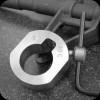
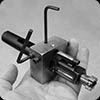
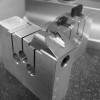
New Pocket MOACKS The Pocket MOACKS is for the guy who needs a carrier key staker that takes up less room in the toolbox or travel kit and weighs a lot less.... and costs less, too. The penalty of course is that it does not have some of the "bonus" features of the original MOACKS, and it is a little slower to do a carrier with, but the size and weight advantage will be worth it to some. Also, it does one thing the MOACKS does not-- it can be used to counter stake the screw heads, an important part of the process if you ask me. The P-MOACKS stakes the carrier key screws one at a time. Like the MOACKS it comes with the Allen wrenches necessaryto do the job, a 9/64 wrench for tightening the carrier key screws, and a 1/8 wrench for those carriers that use a non-standard screw with a 1/8 socket instead of the standard 9/64. With the P-MOACKS, the 9/64 or 1/8 wrench is used to position the tool properly by putting the wrench stem though a hole in the top of the tool and into a carrier key screw socket. Then the staker screw is turned in to touch, then turned in another 1 & 1/4 turns. Repeat four times. To counter stake the screws, move the staker screw to the tapped hole in the top of the tool. Again use the 1/8 or 9/64 wrench to locate the tool to a carrier key screw socket. Once the tool is located, the staker screw is turned in to touch the top of the carrier key screw head, plus one turn. Now there is screw head metal displaced outwardly that will impinge on the inwardly-displaced metal from the staking of the carrier key over the screw heads. Repeat once per carrier key screw. The new tool, like the MOACKS, is made from gen-u-ine gun steel, not reconstituted car bodies-- it's Crucible Steel 420 stainless. These are $75 plus $10 S&H to anywhere in the US or to APO's.
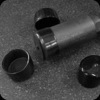
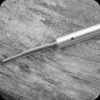
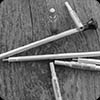
This reamer is designed as an easy, quick and sure way to know. The original version ($210) is provided with an extension T-handle that has a Nylon bushing on it, so you can just open the upper receiver, remove the bolt group, drop it in with some oil, and slowly turn it in (clockwise only, never reversing it), using a lot of turns and very little pressure. The Nylon bushing centers the extension in the upper receiver. When it bottoms out on the chamber's shoulder it will spin freely-- it has stopped cutting and you are done. When you have done this, you know for sure you have chamber with proper 5.56 dimensions in the critical freebore and throat area. Primer popping due to pressure spikes in a short leade will cease, but be advised there can be other factors in popped primers such as hot ammo, hot chambers, and improperly loaded ammo. The new version ($240, shown above) has a redesigned handle that is custom machined from aluminum barstock, so it is quite a bit lighter (handle and reamer weigh less than the original handle alone). It is also shorter to take up less room in your toolbox, and, most importantly, it functions as a storage case for your reamer. When you are finished reaming, simply remove the reamer, reverse it, and insert it into the handle-- your expensive tool is now very well protected and not taking up extra room in your toolbox. There is also a slot in the handle to accept the Allen wrench you need to turn the set screw that retains the reamer. The Allen wrench is retained in the handle so everything you need is right there. What about chromed chambers? The good news is that in our experience, Colt AR15 chrome-lined barrels have a proper 5.56 chamber. I would consider any others to be suspect. The reamer has been subjected to a secondary heat-treating process, titanium carbo-nitride, which makes it capable of correcting under-spec chromed chambers. Obviously it will do fewer of them, and I can't say what the numbers would be as I have not had to ream that many chromed ones yet. Will removing the chrome be a problem? No. Plenty of AR's don't have chromed bores and chamber and they work fine. I've sectioned some chromed barrels and the chrome doesn't last long in the throat area anyway. Removing chrome in the chamber won't cause the area to peel like bumper chrome. Reamer with original-style: $210 Reamer with new lightweight/compact handle that doubles as reamer storage: $240 |
||||||||||